“`yaml — title: “Blender OEM ODM Services and Electric Hot Pot OEM Manufacturer Buying Guide for Wholesale Buyers” meta_description: “A wholesale buyer’s guide to MOQ, certification, and supplier risk when comparing blender OEM ODM services and hot pot manufacturers.” slug: “blender-oem-odm-services-electric-hot-pot-oem-manufacturer-buying-guide” date: “2025-02-14” author: “Magi Team” categories:
- “OEM & ODM”
- “Wholesale Buying Guide”
- “Small Kitchen Appliances”
tags:
- “blender oem odm services”
- “electric hot pot oem manufacturer”
- “MOQ”
- “product certification”
- “wholesale sourcing”
- “private label appliances”
core_keywords:
- “blender oem odm services”
internal_links:
- “https://magicook.store/product/magicook-6-blade-blender-1000w-powerful-electric-blender-for-smoothies-juices-grinding-gold-blue/”
- “https://magicook.store/product/magicook-6-blade-blender-1000w-powerful-electric-blender-for-smoothies-juices-grinding-gold/”
- “https://magicook.store/product/magicook-6-blade-blender-1000w-powerful-electric-blender-for-smoothies-juices-grinding/”
external_links:
- “https://www.cpsc.gov/”
— “`
Blender OEM ODM Services and Electric Hot Pot OEM Manufacturer Buying Guide for Wholesale Buyers
Blender OEM ODM services often get compared on the wrong variables first: unit price, wattage, jar capacity, packaging visuals, or a fast sample turnaround. The same is true when buyers evaluate an electric hot pot OEM manufacturer. On paper, many suppliers can look similar. In execution, they are not. What separates a smooth launch from delayed shipments, compliance friction, excess inventory, or post-sale claims is usually not the datasheet. It is the operating reality behind MOQ, certification readiness, engineering discipline, and supplier coordination.
For importers, distributors, and private-label buyers, the real decision is not simply “Which model is cheaper?” It is “Which supplier lowers my business risk while still supporting margin, launch timing, and brand reputation?”
Why wholesale buyers still get stuck after comparing multiple suppliers
A common sourcing pattern goes like this:
- Request catalogs from several factories
- Compare motor power, housing material, and quoted price
- Ask for MOQ and lead time
- Narrow down based on sample impression
This feels rational, but it often misses the deeper causes of poor outcomes.
A supplier can offer an attractive quotation and still create hidden cost through:
- Inflexible MOQ structures
- Incomplete compliance documentation
- Weak change-control during production
- Unclear spare parts and after-sales support
- Packaging or labeling errors at shipment stage
- Poor alignment between engineering, sales, and QC teams
This is why buyers who keep repeating side-by-side product comparisons can still fail to solve the real problem. The real problem is usually execution risk, not just product selection.
For brands sourcing countertop appliances, whether blenders or electric hot pots, the stronger buying question is: Can this manufacturer support a repeatable, compliant, commercially viable program over time?
What matters beyond the datasheet
A datasheet is useful, but it is only a starting point. Professional buyers should assess a supplier through four layers:
1. Commercial fit
Does the supplier’s MOQ, pricing structure, and customization path fit your forecast and cash flow?
2. Compliance fit
Can the supplier support the destination market’s certification, labeling, and safety requirements?
3. Operational fit
Can they hold schedule, manage component sourcing, and control quality consistently?
4. Brand fit
Can they help you launch a product your customers will trust, reorder, and recommend?
In practice, these four layers matter more than one extra feature on a product sheet.
MOQ is not just a quantity issue
MOQ gets treated as a number, but for wholesale buyers it is really a risk allocation tool.
A factory’s MOQ affects:
- Inventory exposure
- Working capital pressure
- Packaging complexity
- SKU strategy
- Market testing flexibility
- Reorder speed
- Forecast accuracy
A low quoted MOQ can sound attractive, but buyers should ask what sits behind it. Sometimes a low MOQ means:
- Fewer customization options
- Shared packaging components
- Limited color choices
- Higher per-unit cost
- Longer replenishment timelines
- Less control over accessory configuration
On the other hand, an excessively high MOQ can lock buyers into slow-moving inventory before market demand is validated.
How to assess MOQ properly
Instead of asking only “What is your MOQ?”, ask:
- Is MOQ different for standard models vs private-label versions?
- Is MOQ tied to color, plug type, packaging design, or voltage variant?
- Can mixed models be combined into one order?
- What is the MOQ for repeat orders after the initial run?
- What components drive the MOQ most: motor, heating element, PCB, jar, carton, or gift box?
- Can pilot runs be structured before a full launch?
A supplier who explains MOQ transparently is often easier to work with later when forecasts change.
The better question: what MOQ supports a healthy launch?
The right MOQ is the one that balances:
- manageable stock risk,
- acceptable landed cost,
- realistic sell-through,
- and enough room for quality control and branding consistency.
That is a more strategic standard than simply “lowest MOQ wins.”
Certification is where sourcing mistakes become expensive
For small kitchen appliances, compliance failures rarely appear at the quotation stage. They appear later, when labels, test reports, declarations, or import documentation are reviewed. By then, delays are expensive.
Whether you are sourcing from an electric hot pot OEM manufacturer or evaluating blender OEM ODM services, certification should be reviewed early, not near shipment.
Depending on target market and product category, buyers may need to confirm:
- Product safety certification status
- Market-specific electrical compliance
- Food-contact material considerations where relevant
- Labeling and user manual requirements
- Packaging warning statements
- Traceability and batch identification
- Factory documentation consistency
If you sell into the United States, it is also useful to stay aware of product safety expectations and recall frameworks through sources such as the U.S. Consumer Product Safety Commission.
Certification is not only about having a document
A common mistake is assuming that a certificate file equals compliance readiness.
Buyers should verify:
- Is the certificate current?
- Does it apply to the exact model or only a similar platform?
- Does the report match the product configuration being ordered?
- Will changes to plug, housing, heating system, motor, or controls affect validity?
- Is the brand label information aligned with the documentation?
This matters because last-minute product changes can create downstream issues if the compliance basis no longer matches the shipped goods.
H3: The hidden cost of weak certification discipline
Weak certification discipline can lead to:
- shipment holds,
- relabeling costs,
- customs complications,
- delayed retail onboarding,
- marketplace listing rejection,
- and reputational damage.
For B2B buyers, that is not just a technical issue. It is a margin issue and a trust issue.
How professional buyers should evaluate an electric hot pot OEM manufacturer
Even if your broader sourcing program includes blenders, kettles, or multi-category kitchen appliances, the evaluation logic for an electric hot pot supplier is clear.
A credible electric hot pot OEM manufacturer should be able to discuss:
- thermal safety considerations
- lid, handle, and housing durability
- power-cord and plug standards
- boil-dry or overheating protection if applicable
- food-contact material consistency
- carton drop resistance for export handling
- spare part and replacement policy
- production line quality checkpoints
Notice that none of these points begin with color options or promotional packaging. That is intentional. Product appeal matters, but performance consistency and compliance readiness matter first.
The same sourcing logic applies to blender OEM ODM services
The category changes. The buyer risk does not.
When reviewing blender OEM ODM services, buyers should assess:
- motor consistency across batches
- blade assembly reliability
- jar material suitability
- vibration and noise control
- packaging protection for cross-border transport
- voltage and plug adaptation
- accessory and spare-part availability
- branding and labeling execution
For teams building a private-label range, it is often smarter to choose a supplier that can support stable repeatability rather than chase the cheapest opening quotation.
If you are evaluating market-ready blender options, these product references can help benchmark design direction and positioning:
- MagiCook 6-blade blender 1000W in gold blue
- MagiCook 6-blade blender 1000W in gold
- MagiCook 6-blade blender 1000W standard version
These links are useful not because a buyer should start with aesthetics, but because good sourcing decisions connect product direction with actual channel needs, packaging realities, and reorder potential.
Questions that reveal whether a supplier is dependable
Professional sourcing teams often get better answers by changing the questions.
Ask:
- What usually causes delays in this product category?
- Which components have the longest replenishment cycle?
- What changes after sample approval are most risky?
- How do you manage incoming inspection and final QC?
- What percentage of your orders are repeat private-label programs? [TO CONFIRM]
- What documents are available before deposit, before production, and before shipment?
- How do you handle nonconformity if packaging or labeling is wrong?
- What support is available after goods arrive?
These questions move the conversation from selling to operating. That is where dependable suppliers become visible.
A practical shortlist framework for wholesale buyers
If you are comparing multiple factories, score each one across the following criteria:
| Criterion | What to look for | |—|—| | MOQ logic | Flexible but commercially realistic structure | | Certification readiness | Current, relevant, and model-specific documentation | | Engineering clarity | Direct answers on safety, materials, and configuration limits | | QC process | Defined checkpoints, not vague assurances | | Communication | Fast, clear, and technically consistent | | Change management | Ability to control revisions after sample approval | | Packaging support | Export-safe packaging and labeling discipline | | After-sales support | Process for claims, replacement parts, and issue tracking |
This kind of framework reduces decision bias. It also helps internal teams justify supplier selection beyond a simple price comparison.
Image placement suggestions
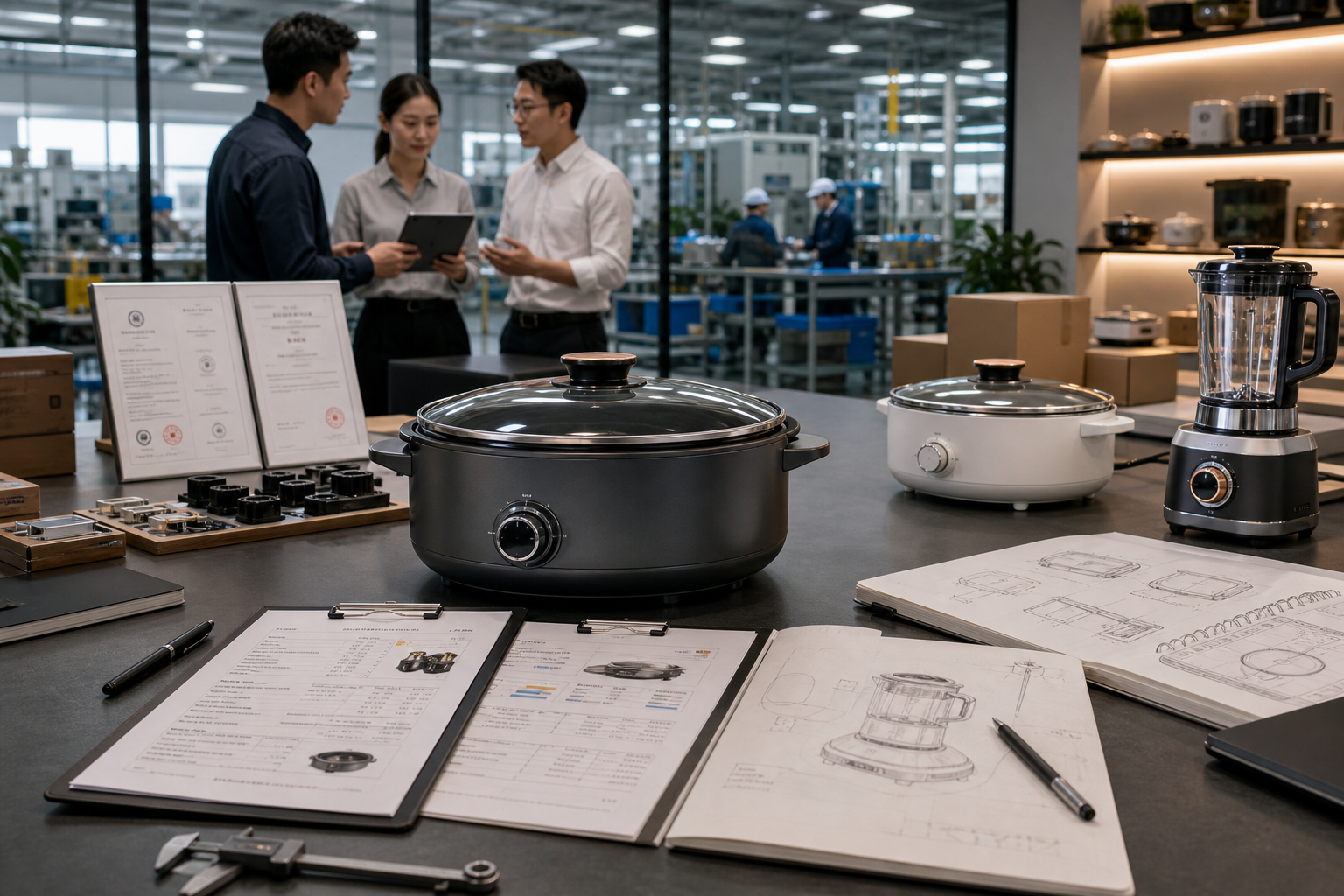
- [Image: Procurement manager reviewing appliance compliance documents and MOQ planning spreadsheet. Alt text: “Wholesale buyer evaluating MOQ and certification for small kitchen appliance OEM sourcing”]
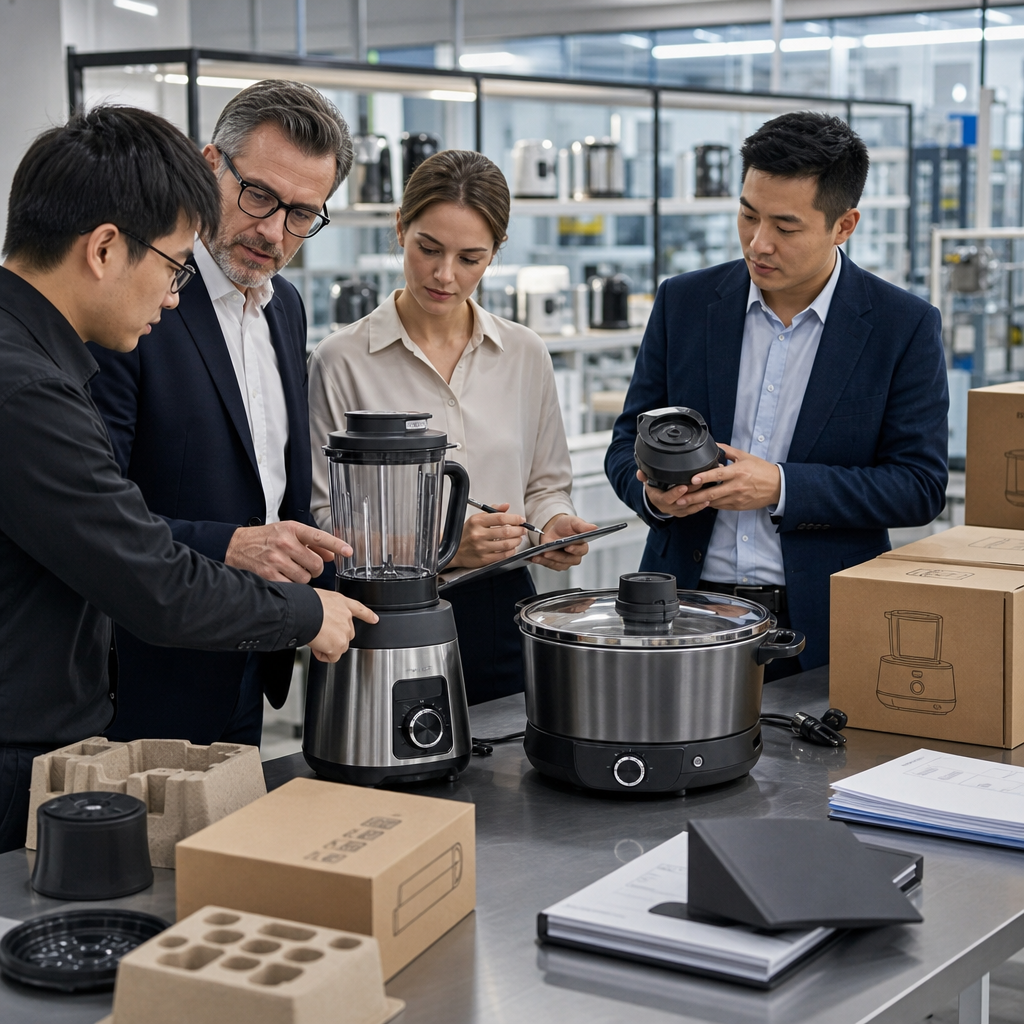
- [Image: Factory-side quality inspection of blender components and packaging before export. Alt text: “Quality control process for blender OEM ODM services before shipment”]
- [Image: Comparative checklist for electric hot pot OEM manufacturer and blender supplier evaluation. Alt text: “Supplier assessment checklist for electric hot pot and blender private label programs”]
FAQ
Frequently Asked Questions
What is the most important factor when choosing an electric hot pot OEM manufacturer?
The most important factor is not price alone. It is the supplier’s ability to deliver compliant, consistent products with a workable MOQ and reliable production control. A lower quote can become more expensive if certification, packaging, or quality execution fails.
How should buyers evaluate MOQ in blender OEM ODM services?
Buyers should evaluate MOQ in relation to customization level, cash flow, inventory risk, and reorder flexibility. The right MOQ supports a healthy launch without forcing excess stock or limiting essential branding requirements.
Why is certification review necessary before placing an order?
Certification review is necessary because product configuration, labeling, destination market rules, and documentation must match. If they do not, buyers can face shipment delays, relabeling costs, customs issues, or sales-channel rejection.
Is it risky to select a supplier based only on samples and price?
Yes. Samples and price show only a small part of supplier capability. They do not prove batch consistency, compliance discipline, packaging execution, or after-sales responsiveness. Those areas often determine whether a program scales successfully.
Can one sourcing framework work for both hot pots and blenders?
Yes. While technical details differ, the core sourcing framework is similar: verify MOQ logic, certification readiness, QC systems, engineering communication, packaging control, and repeat-order stability.
Conclusion
Wholesale appliance sourcing becomes easier when buyers stop asking only, “Which quote looks better?” and start asking, “Which supplier reduces business risk over the next 12 months?”
That shift matters. It protects margin, launch timing, customer trust, and internal confidence.
If your team is reviewing blender OEM ODM services or comparing an electric hot pot OEM manufacturer, focus beyond the datasheet. MOQ structure, certification discipline, and execution quality are what turn a product decision into a dependable supply program.
To explore practical product benchmarks and sourcing direction, review the MagiCook blender range through the product pages above and use them as a reference point for a more grounded supplier conversation.