Choosing blender OEM ODM services is not only about unit price. For wholesale buyers, the real decision is whether a manufacturer can meet your MOQ target, support the right certifications, maintain consistent quality, and scale with your brand over time. A structured checklist helps reduce sourcing risk before tooling, packaging, and shipment begin.
If you are comparing factories for private label or custom development, this guide explains what to verify, what questions to ask, and where MOQ and certification requirements typically affect timelines, cost, and product compliance.
What blender OEM ODM services mean for wholesale buyers
For many importers, distributors, and brand owners, blender OEM ODM services cover two common sourcing models:
- OEM: You provide product requirements, branding, packaging, or technical specifications, and the factory manufactures to your brief.
- ODM: The factory offers an existing product platform that can be customized with your logo, colors, packaging, and selected features.
A simple way to think about it: OEM usually gives you more product control, while ODM often reduces development time and startup cost.
For wholesale buyers, this matters because MOQ, tooling, lead time, certification scope, and testing responsibility can differ significantly between the two models.
Why MOQ and certification should be your first filters
MOQ and certification are often treated as final-stage details, but they should be early screening criteria.
MOQ determines commercial feasibility. If a supplier requires a production run larger than your sales forecast or warehouse capacity, your cash flow risk increases.
Certification determines market access. If the blender does not meet the safety and labeling requirements of your destination market, the shipment may face delays, penalties, or rejection.
A reliable supplier should be able to explain:
- Standard MOQ by model
- MOQ for logo printing
- MOQ for custom color or housing changes
- MOQ for gift box and carton customization
- Existing certifications by market
- Additional test requirements for new markets
For U.S. importers, it is also useful to review guidance from the U.S. Consumer Product Safety Commission when assessing consumer product safety expectations and compliance responsibilities.
Manufacturer checklist for blender OEM ODM services
Below is a practical evaluation checklist you can use during supplier shortlisting and quotation review.
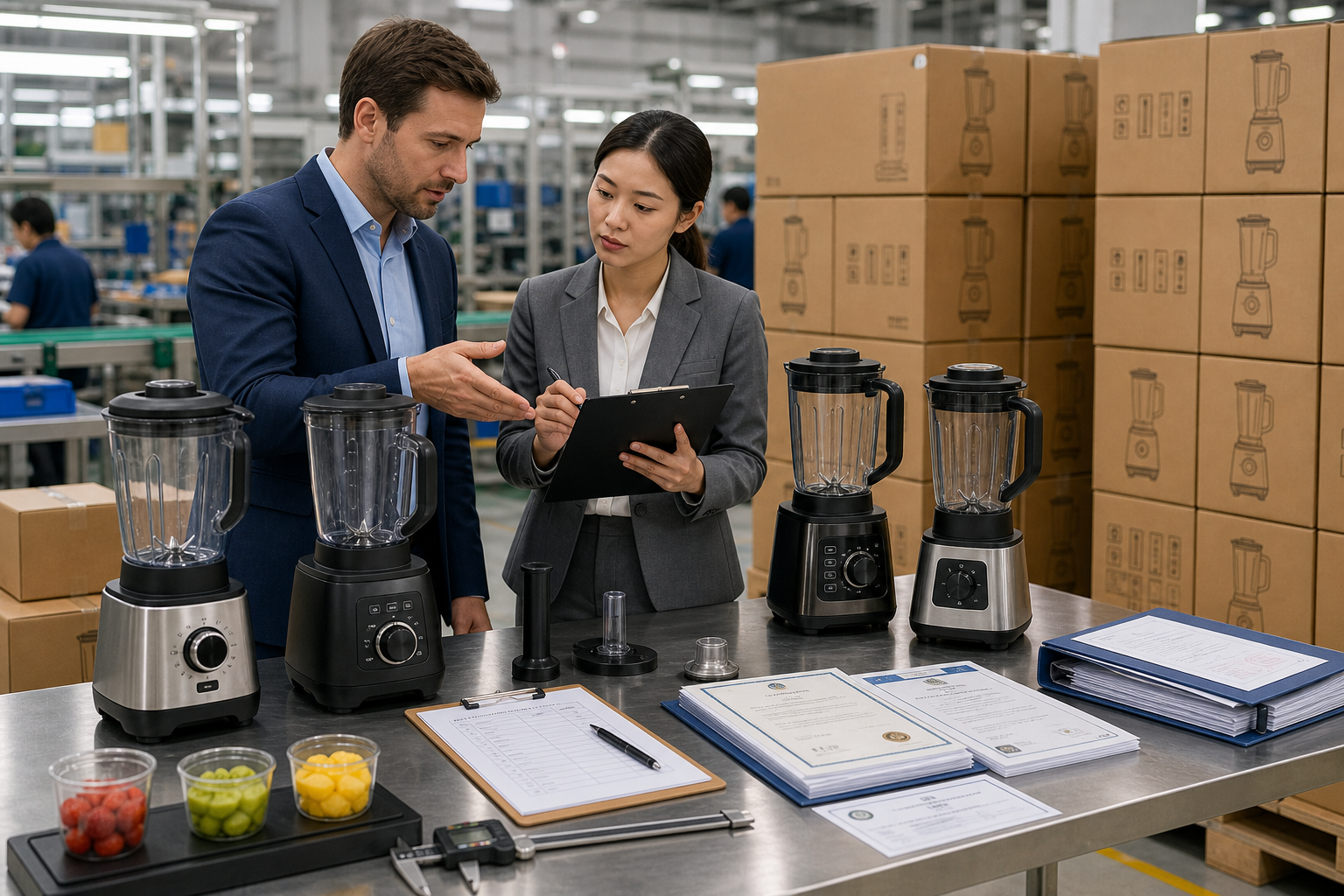
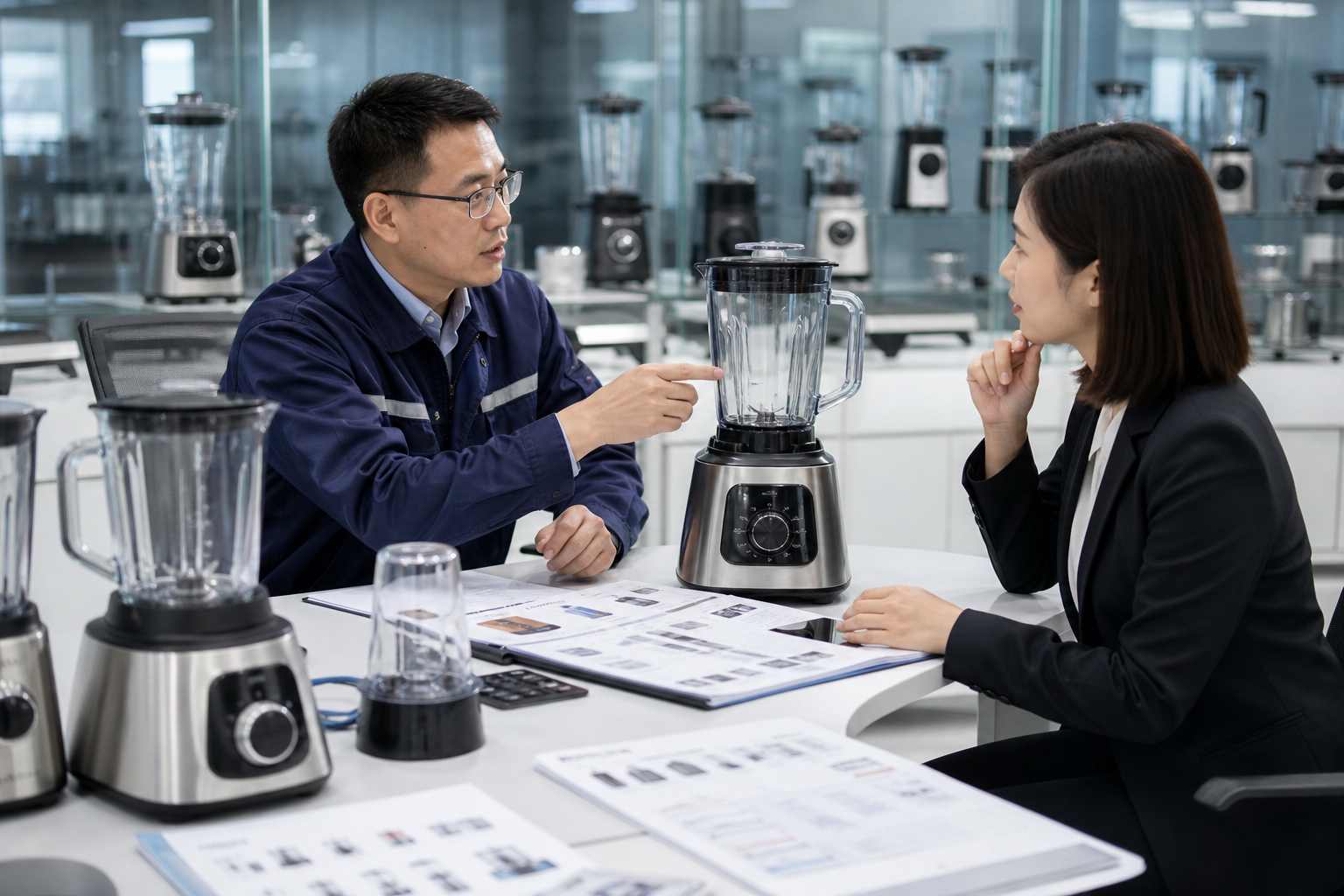
1. Confirm whether the factory is truly a manufacturer
Not every supplier offering OEM or ODM is the actual factory. Some are trading companies, and that can affect pricing, communication speed, and control over technical changes.
Ask for:
- Factory audit reports or certifications
- Production line photos or videos
- Business license details
- Main product categories
- Export markets served
- Typical monthly output
A manufacturer with stable experience in small appliances is usually better positioned to manage motor performance, blade assembly consistency, jar material sourcing, and electrical safety checks.
2. Check product specialization and category overlap
A factory that already builds kitchen appliances often has stronger component sourcing and compliance experience. That matters if your sourcing strategy extends beyond blenders.
For example, a supplier with adjacent capabilities in heating appliances may also support projects related to an electric hot pot oem manufacturer program. This can be useful if you plan to build a broader kitchen appliance portfolio with one coordinated supply base.
However, category overlap should not replace model-specific validation. A factory may be strong in one appliance line and average in another.
3. Clarify MOQ structure in detail
MOQ is rarely one single number. Buyers should separate MOQ into several layers.
Types of MOQ to verify
- Base MOQ per model
- MOQ per color
- MOQ for custom logo
- MOQ for custom packaging
- MOQ for accessory changes
- MOQ for voltage or plug variation
- MOQ for exclusive mold or tooling
A supplier may advertise a low MOQ, but the practical MOQ for your branded configuration can be much higher once packaging, inserts, manuals, and plug standards are included.
Ask for a quotation table that shows:
| MOQ Item | Standard Option | Custom Option | |—|—|—| | Product unit | Existing model MOQ | MOQ with feature changes | | Color | Stock color | MOQ per custom Pantone | | Branding | Sticker/logo print | Molded logo or custom plate | | Packaging | Neutral box | Custom gift box MOQ | | Manuals | Generic manual | Country-specific manual MOQ |
This prevents misunderstandings later in the project.
4. Verify certification readiness by target market
Certification is one of the most important filters in blender OEM ODM services. A blender sold in one region may require different testing, labeling, plug types, manuals, and packaging warnings in another.
Common areas to review include:
- Electrical safety certification
- EMC or electromagnetic compatibility
- Food-contact material compliance
- RoHS or restricted substances, when relevant
- Packaging and labeling requirements
- User instruction language requirements
Ask the supplier:
- Which certifications are already available for this model?
- Are certificates issued for the exact model or a similar platform?
- Will modifications affect certificate validity?
- Who pays for retesting if features change?
- Can they provide test reports, not just certificate summaries?
A dependable supplier should provide organized compliance documentation, not vague promises.
Quality control points wholesale buyers should inspect
Certification gets a product into the market. Quality control keeps it in the market.
For blenders, QC should cover both safety and performance. Ask about incoming inspection, in-process inspection, and finished-goods testing.
Key checkpoints include:
- Motor wattage consistency
- Blade hardness and assembly accuracy
- Jar impact resistance
- Lid sealing performance
- Switch and control durability
- Overheat protection
- Voltage and plug conformity
- Noise and vibration level
- Drop test and carton integrity
- Final random inspection before loading
A good supplier should explain defect classification and acceptable quality limits. If they cannot describe their QC system clearly, that is a warning sign.
[Image suggestion: Quality inspector testing blender motor performance on an assembly line. Alt text: “Quality control inspection for blender OEM ODM services in a small appliance factory”]
Product samples: what to test before placing a bulk order
Never rely on a catalog alone. Sampling is where many sourcing assumptions are corrected.
When evaluating a blender sample, test:
- Smoothie performance with soft fruit
- Ice crushing consistency, if claimed
- Heat buildup after repeated use
- Ease of cleaning
- Blade stability after multiple cycles
- Jar locking accuracy
- Lid leakage during operation
- Packaging protection during transit simulation
Also compare the sample against your retail positioning. A product suitable for entry-level ecommerce may not suit a premium retail placement.
If you want a benchmark for style, motor strength, and blade presentation, review MagiCook’s 1000W powerful blender for smoothies and juices in gold blue and the 1000W blender for private label style evaluation in gold. These product references help buyers visualize the kind of configuration and presentation often requested in wholesale programs.
Questions to ask about tooling, customization, and lead time
Customization can improve market fit, but it also changes cost and schedule. Before committing, ask where your project sits on the customization spectrum.
Typical customization levels:
- Logo printing only
- Color box redesign
- Housing color adjustment
- Accessory or jar modification
- Motor or control feature change
- New mold development
Each level can affect:
- MOQ
- Unit cost
- Development cost
- Retest requirements
- Production lead time
A useful supplier response should include estimated timelines for:
- Artwork confirmation
- Sample preparation
- Packaging approval
- Mass production
- Final inspection
- Shipment booking
This is especially important for seasonal launches or promotional retail windows.
Packaging, labeling, and documentation review
For wholesale buyers, packaging is part compliance and part brand experience.
Check whether the supplier can support:
- Retail gift box design
- Export master carton specification
- Barcode placement
- Warning labels
- Instruction manuals
- Country-specific compliance marks
- Spare parts and after-sales inserts
Make sure packaging claims match actual tested performance. If a carton says “ice crushing” or “1000W,” those claims should be supported by product specifications and test records.
For buyers seeking a general-purpose product reference, the MagiCook 6-blade 1000W blender product page shows the kind of feature-led presentation many distributors look for when comparing base models.
[Image suggestion: Custom blender packaging mockup with barcode, compliance icons, and instruction manual. Alt text: “Custom packaging review for wholesale blender OEM ODM project”]
Commercial terms that matter beyond unit price
Unit price is important, but it is not enough for supplier comparison. A lower quote can become more expensive if it includes weaker packaging, poor components, or unclear defect handling.
Review these commercial terms carefully:
- Deposit and balance terms
- Tooling ownership
- Sample charges and refund conditions
- Spare parts support
- Warranty responsibility
- Late delivery penalties, if applicable
- Inspection rights
- Claim handling process
- Replacement policy for defects
Ask suppliers to quote on the same basis so you can compare fairly. Even a small difference in packaging thickness, motor grade, or blade material can change long-term product performance.
Red flags when evaluating a blender supplier
A supplier may look competitive at first glance but still present operational risk. Common red flags include:
- They cannot explain MOQ logic clearly
- Certificates do not match the exact product model
- Sample quality differs from quoted specifications
- Lead times change frequently without reason
- Communication on technical details is vague
- They avoid sharing QC procedures
- Product photos appear inconsistent across listings
- They cannot confirm whether changes affect compliance
A trustworthy manufacturer does not need to overpromise. Clear process visibility is usually a stronger sign than aggressive pricing.
A simple sourcing scorecard for wholesale buyers
If you are comparing multiple factories, use a weighted scorecard. This helps turn supplier discussions into a repeatable decision process.
Suggested scoring categories:
- MOQ fit: 20%
- Certification readiness: 20%
- Sample performance: 20%
- Quality control system: 15%
- Customization capability: 10%
- Lead time reliability: 10%
- Communication and documentation: 5%
This approach is especially useful for buyers managing both blenders and adjacent product categories, including programs that may involve an electric hot pot oem manufacturer in the same sourcing network.
[Image suggestion: Supplier evaluation scorecard with columns for MOQ, certification, QC, and lead time. Alt text: “Wholesale buyer checklist for evaluating blender OEM ODM services”]
FAQ: blender OEM ODM services
What is the difference between OEM and ODM for blenders?
OEM means the blender is produced according to your specifications, branding, or packaging requirements. ODM means the manufacturer offers an existing blender design that you customize to a limited or moderate degree. OEM usually offers more control, while ODM often reduces development time and upfront cost.
What MOQ is normal for blender OEM ODM services?
MOQ varies by model and customization level. A standard existing model may have a lower MOQ, while custom color, packaging, or feature modifications usually increase the minimum order quantity. Buyers should always request MOQ by model, color, packaging, and plug type rather than asking for only one MOQ number.
Which certifications should I ask for when importing blenders?
You should ask for certifications and test reports relevant to your target market, including electrical safety, EMC, and food-contact compliance where applicable. Also verify whether the documents apply to the exact model you are sourcing and whether any modifications will require retesting.
How do I know if a blender supplier is reliable?
Check whether the supplier can provide factory information, clear certification documents, consistent samples, defined QC procedures, and a realistic production timeline. Reliable suppliers answer technical questions directly and document commercial terms in detail.
Can one supplier handle blenders and other kitchen appliance OEM projects?
Sometimes yes. A small appliance manufacturer may support multiple categories, including blender lines and projects related to an electric hot pot oem manufacturer program. Still, each category should be evaluated separately for certification, engineering, and production capability.
Conclusion
Selecting the right partner for blender OEM ODM services requires more than comparing quotations. Wholesale buyers should confirm the real MOQ structure, verify certification readiness for the destination market, inspect quality control procedures, and test samples under practical use conditions.
If you are building or expanding a kitchen appliance line, start with proven product references and a disciplined supplier checklist. Explore the MagiCook blender range to benchmark features, presentation, and market positioning, then move forward with sourcing decisions backed by documentation rather than assumptions.