In blender oem odm services, many buyers begin the same way: compare unit price, wattage, jar size, blade count, and packaging options. On paper, that seems rational. But in practice, many sourcing teams still end up with delays, compliance concerns, unstable quality, and difficult post-launch support. The same pattern appears when evaluating an electric hot pot oem manufacturer. The issue is not a lack of comparison. It is that the wrong variables are being compared first.
For importers, distributors, brand owners, and project buyers, the real purchase decision is rarely about a single appliance. It is about risk transfer, market readiness, margin protection, and whether the supplier can help your business deliver consistently under pressure.
Why price-first sourcing often creates expensive problems later
Low quoted pricing can look attractive during initial supplier screening. However, factory selection based mainly on price and visible specs often hides the costs that appear after the purchase order is placed.
These hidden costs typically include:
- Higher defect rates
- Packaging failures during shipment
- Documentation gaps for customs or marketplace compliance
- Delayed mass production after sample approval
- Inflexible MOQ structures
- Weak spare parts support
- Slow communication when problems appear
For small and mid-sized brands, these issues can erase any savings from a lower unit cost. For larger buyers, the problem is bigger: a weak supplier can affect launch calendars, retailer relationships, and brand reputation across multiple SKUs.
That is why professional buyers increasingly look beyond the spec sheet. A factory is not just a production source. It is an operational partner that affects forecasting, compliance, and customer trust.
The real sourcing question: can this supplier support a viable business model?
A product may look nearly identical across several factories. A 1000W blender, six blades, similar jar capacity, and comparable packaging can create the illusion that all suppliers are interchangeable.
They are not.
In B2B appliance sourcing, the more important question is this:
Can the supplier support your business model with acceptable risk, realistic MOQ, reliable certification, and repeatable quality?
This is where many buyers get stuck. They compare product features repeatedly, but what they actually need is clarity on execution. If your goal is to build a sustainable private-label or distribution business, execution quality matters more than a slightly lower ex-factory price.
MOQ is not just a number. It is a cash-flow and flexibility decision.
Minimum order quantity is often treated as a negotiation point. In reality, MOQ is a strategic filter.
A supplier with an unrealistic MOQ may create pressure in several ways:
- More inventory than your demand forecast supports
- Slower cash conversion
- Greater warehouse exposure
- Higher markdown risk if packaging or branding needs to change
- Less flexibility to test new markets or channels
This matters whether you are sourcing blender oem odm services or evaluating an electric hot pot oem manufacturer. The right MOQ should reflect your route to market, reorder rhythm, and tolerance for inventory risk.
What buyers should check about MOQ
1. MOQ by model vs MOQ by packaging
Some factories quote a favorable MOQ, but that quantity only applies to a standard product without custom branding, carton design, or accessory variations. Ask whether MOQ changes based on:
- Color options
- Gift box customization
- Voltage variants
- Plug types
- User manual language requirements
- Regional labeling needs
2. MOQ for spare parts and after-sales support
After-sales planning is often ignored during sourcing. Ask what minimums apply to replacement jars, blades, lids, motors, or switches. A low initial product MOQ means less if spare part support is difficult later.
3. MOQ impact on lead time
Some factories accept a lower MOQ but place smaller orders behind larger customers in production scheduling. Clarify whether lower-volume orders face extended lead times during peak periods.
A practical supplier should help you understand the trade-off between MOQ, customization, cost, and delivery. That is often a sign of a more mature manufacturing partner.
Certification is not a formality. It is market access protection.
Many buyers ask about certification late in the process, after samples have been approved. That can be costly.
Certification is not just about paperwork. It can affect:
- Import clearance
- Marketplace listing approval
- Retailer onboarding
- Insurance exposure
- Product liability risk
- Consumer trust
For small domestic appliances, certification requirements vary by market. A responsible sourcing process should confirm exactly which standards and test reports are needed for the target region before mass production begins.
For example, buyers selling into the United States should stay aligned with consumer product safety expectations and monitor relevant guidance from authorities such as the U.S. Consumer Product Safety Commission.
Why certification matters more than a factory saying “we’ve done this before”
A common sourcing mistake is relying on broad verbal reassurance. Statements like “we export to many countries” or “this model already passes” are not enough. Buyers should verify:
- Whether the certificate applies to the exact model
- Whether the report is current
- Whether branding changes affect labeling requirements
- Whether electrical components or material changes trigger retesting
- Whether the test lab is recognized for the target market
In other words, certification should be handled as part of project control, not sales conversation alone.
The hidden link between certification, quality control, and brand reputation
Buyers sometimes separate certification from quality. In practice, they are closely linked.
A product can pass a test sample stage yet still cause issues if production consistency is weak. Material substitutions, poor assembly control, inconsistent components, or untracked process changes can create risk between sample approval and bulk shipment.
That is why capable OEM and ODM partners should be evaluated on more than documentation. Look for evidence of process discipline, including:
- Incoming material inspection
- In-line production checks
- Final random inspection
- Batch traceability
- Corrective action procedures
- Packaging drop-test or transit-readiness controls [TO CONFIRM]
These controls matter because your customer does not experience your factory. They experience your brand.
Repeated supplier comparisons can delay the real decision
There is a point where more comparison stops adding clarity and starts increasing risk.
Many teams keep collecting quotations because they want certainty. But endless comparison often masks a deeper concern: fear of making the wrong commitment. That fear is reasonable. Appliances carry specification pressure, compliance expectations, and margin consequences.
Still, the answer is not more spreadsheets alone.
The answer is to compare suppliers using business-critical criteria:
- Can they support your target market’s certification path?
- Can they work with an MOQ aligned to your demand plan?
- Can they maintain quality consistency across repeat orders?
- Can they communicate clearly during artwork approval and production?
- Can they support customization without creating avoidable delays?
- Can they help protect your launch timeline?
When evaluated this way, the supplier conversation becomes more strategic and less transactional.
How blender OEM ODM services should be evaluated in a B2B sourcing process
If you are sourcing under a private-label or distribution model, blender oem odm services should be assessed across five dimensions.
1. Commercial fit
This includes unit economics, payment structure, tooling implications [TO CONFIRM], and MOQ flexibility. The goal is not simply to get the cheapest quote, but to build a cost structure that supports sell-through and replenishment.
2. Technical fit
A blender’s visible specifications matter, but so do motor consistency, blade assembly quality, noise expectations [TO CONFIRM], container durability, and user safety design. Technical fit should reflect your end market, not just catalog parity.
3. Compliance fit
Make sure the supplier can support the certification and documentation path for your destination market. This should be validated before final PO confirmation.
4. Operational fit
This includes lead time reliability, production planning, carton marking accuracy, and responsiveness during revision cycles. A technically capable supplier can still be a poor operational fit.
5. Reputation fit
Your chosen manufacturer becomes part of your customer experience, even if invisible. If returns increase or complaints rise, your brand absorbs the damage.
A practical example: from product sourcing to business readiness
A buyer reviewing an electric hot pot oem manufacturer may receive three quotations with similar technical specs. One is lowest in price, one offers faster lead time, and one asks better questions about destination market, carton marks, and certification.
The third supplier may initially seem less “competitive” because the quote is not the lowest. But that supplier may actually reduce project risk by identifying issues before production begins.
The same principle applies to blender oem odm services. A manufacturer that helps you avoid labeling mistakes, unrealistic MOQs, or compliance gaps is not costing you more. They may be protecting your margin, delivery schedule, and customer satisfaction.
That is often the better commercial decision.
Product selection still matters, but it should support the sourcing strategy
Once the supplier framework is sound, product selection becomes more meaningful. For example, if you are exploring dependable blender options for distribution or private-label benchmarking, these references can help you evaluate positioning, finish, and presentation:
- blender OEM ODM services reference in gold blue finish
- 1000W blender OEM ODM services model in gold
- private label blender OEM ODM services product reference
The important point is not to choose based on appearance or visible specs alone. It is to align product choice with market requirements, MOQ reality, packaging expectations, and support capability.
What serious buyers should ask before placing an order
Before moving from quotation to order confirmation, ask these questions:
- What is the MOQ for standard production, and what changes it?
- Which certifications apply to this exact model and target market?
- Are test reports current and tied to the same configuration?
- What is the lead time for sample, first order, and repeat order?
- How are quality checks documented during production?
- What spare parts support is available after shipment?
- What packaging tests or transit protections are used? [TO CONFIRM]
- What happens if production materials need substitution?
- Who manages artwork approval and carton mark verification?
- How are defects or claims handled post-shipment?
A supplier that answers clearly is usually easier to work with when pressure increases.
FAQ
What is the biggest mistake when choosing blender OEM ODM services?
The biggest mistake is focusing too narrowly on price and visible specs. A low quote can become expensive if MOQ is too high, certification is incomplete, or quality control is inconsistent. The better decision is usually the supplier that reduces operational and compliance risk.
Why is MOQ so important in appliance sourcing?
MOQ affects cash flow, inventory exposure, market testing flexibility, and reorder planning. If MOQ is too high, buyers may overcommit capital before real demand is proven. A workable MOQ supports healthier growth and lower risk.
How do I verify certifications from an electric hot pot OEM manufacturer or blender supplier?
Ask for the exact certificate and test report tied to the model you plan to buy, then confirm validity, target market relevance, and whether any product changes affect compliance. Do not rely only on general claims that the factory exports internationally.
Are similar-looking appliance products usually the same quality?
No. Similar appearance or specs do not guarantee the same internal components, process control, documentation quality, or consistency in mass production. Two products can look nearly identical and perform very differently in the field.
What should I prioritize besides product specs?
Prioritize certification readiness, realistic MOQ, production consistency, communication quality, after-sales support, and lead time reliability. These factors have a direct impact on total cost and customer satisfaction.
Conclusion
For professional buyers, the real challenge is not finding another appliance supplier with a similar spec sheet. It is choosing a manufacturing partner that reduces uncertainty.
That is why price and specs alone are not enough. Whether you are comparing blender oem odm services or screening an electric hot pot oem manufacturer, the stronger decision usually comes from evaluating MOQ, certification, execution discipline, and long-term fit.
If you are planning your next appliance sourcing project, explore MagiCook’s product references and use them as a starting point for a more risk-aware evaluation process. The right supplier should do more than make the product. They should help you deliver with confidence.
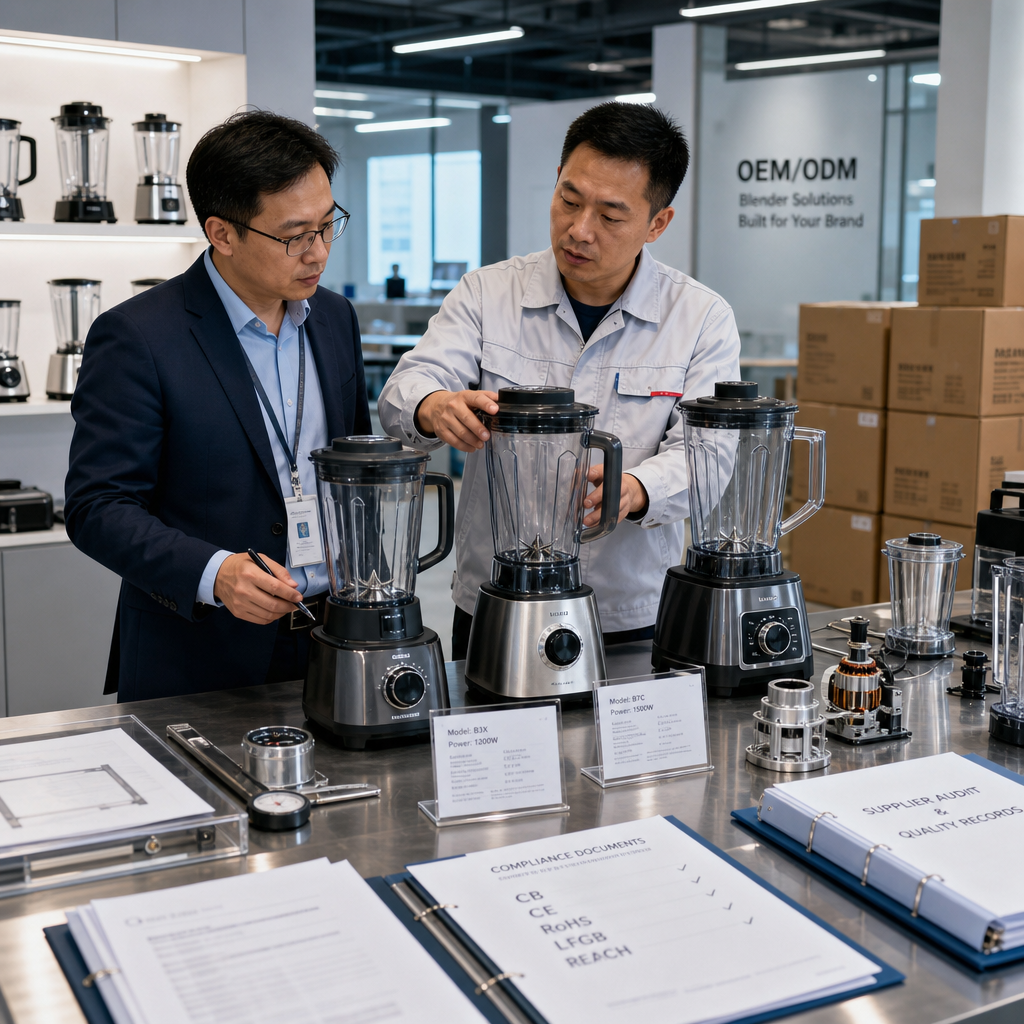
[Image suggestion: B2B sourcing manager reviewing blender product samples, packaging mockups, and compliance documents in a meeting room. Alt text: “B2B buyer evaluating blender OEM ODM services with product samples and certification papers”]
[Image suggestion: Close-up of blender components, packaging, and inspection checklist on a factory quality control table. Alt text: “Quality control process for private label blender manufacturing and certification review”]
[Image suggestion: Warehouse-ready cartons of countertop appliances prepared for export shipment. Alt text: “Export-ready blender OEM ODM shipment with labeled cartons and compliant packaging”]